Tuesday, December 11, 2007

ISM/Sangam


View Larger Map
Map: The HRI is actually in Jhusi, down the long winding road that almost reaches the river. From near the institute you can take a boat upstream towards the confluence (Sangam).

About a week after I arrived at HRI there was a strings conference, the Indian String meeting, which gave me a chance to hear what people here were up to, as well as to give a talk myself. It also meant the visit of Costis who I know from his Queen Mary days, as he is an India veteran having been working in Mumbai for a year now.

Along with Ted, an American post-doc here for two years, and some Indian PhD students we set off one evening to the mythical Hasty and Tasty, a bar-restaurant of ill-repute. The Indian's wanted to tag along with us, but weren't so keen to go to Hasty, as it serves beer and so is considered a bit dodgy (as a consequence of having alcohol there no women there ever!). I actually enjoyed the atmosphere: it had dim lighting and felt like a bar, not a restaurant, unlike anywhere else I'd been here. The beer here comes in 750 ml bottles, many varieties are strong, but the labels says "under 8%" as the brewing process seems a bit random here. My favourite here is Haywards, which fits into the okay as long as it's cold category. Kingfisher is also popular but tastes like cats piss. They also have Indian brewed Fosters. They all are slightly more chemical than they should be. To get to Hasty is a bumpy 20-30min bus ride into town on the free institute minibus.

Later in the week we also got the campus guest house to get us some beer, even on the HRI campus it's considered dodgy and we weren't allowed to drink them on the veranda, instead we had to skulk off to Costis's room in the guest house feeling unclean.

At the end of the week when the conference finished Costis, some of the Indian students and I went on a boat trip from the bank of the Ganges near the institute (you can see the Ganges from my office window and it's a few minutes walk down the road) to the "Sangam". This is the confluence of the Ganges and the Yamuna rivers (along with the mythical underground Saraswati river). Here we could just about see the differing colours where the rivers meet. It's a holy place for Hindus and many bathe in the (very skanky) water nearby. It was a strange boat trip as we spent most of it being pulled by a man walking in the river in front of us, or on the bank beside us (though the river was wide and relatively shallow, the current was too strong for them to do much rowing against. I enjoyed the trip as I generally like being on boats and by water, the Sangam was quite underwhelming really though.

The pictures here are: being pulled up the Ganges with Allahabad fort in the background, On the boat (Me, Rajesh, Ayun, Costis), great plan to disembark on a platform at the Sangam.

Thursday, December 6, 2007

HRI


View Larger Map

On the evening of the 8th of October I arrived at HRI, a bit tired after the train journey. As you can see from the map it fairly central in India, in Uttar Pradesh, in the so called Hindi-belt or cow-belt. Many of the students and faculty here are Bengali and UP is regarded as a bit backward. The town of Allahabad had all the noise, dirt and stray animals, but the Campus itself, not far from the Ganges on the outskirts of town has a nice green, relatively peaceful site with plenty of armed guards on hand.

When I arrved I got the key to my flat. I was expecting a one room studenty affair, but I have a two bedroom flat with a kitchen. Since I'm carrying only one rucksack of posessions it looks very bare. Include are pictures of the main bedroom and front room. The flat has a population of lizards, and pigeons who live ontop of a primative metal airconditioner on my windowsill (it acts as a drum/amplifier when they get rowdy around dawn each morning). I thought I'd escape the terror of the pigeons after they hassled me in my early Cambridge rooms, but they seem to be in every bloody country in the world. Is nowhere safe? There was also lots of building and decorating ahead of an external review a few weeks back. The banging has only now subsided. Again builders seemed to follow me everywhere at the end of last year (reroofing our flat, outside my offices in Cambride and London). Anyway enough moaning. The next day I also was given an office, a whole one to myself this time, which is quite lucky as post-docs here (like most places) have to share. I have the office of a recently departed faculty member.

Meals are taken in the mess, a Canteen like place where you present your metal tray and get rice, daal, 2 mysterious veggie boiled mush things and chapatis. If you're lucky sometimes there are parathas, desserts or salady stuff. It's not bad really, everything (including breakfast) is spiced but not very hot. Things are on a weekly repetition, which changes every month depending who's in charge. However this month they've hardly changed it so it's getting very repetitive.

There's also a "pantry" where you can get tea (chai). It recently moved to shiny new premises with a crazy voucher system whereby you have to by tokens beforehand and then exchange them for tea. Genius. They were letting me just pay with money, but a warning email went round about this and I have to buy a big book of tokens now (not from the pantry itself, no, from reception or some mysterious office, which often run out of tokens so you can't get any tea!).

Well I seem to be ranting a bit in this post but all in all life on the Campus is fine, it's much cleaner and safer than outside but pretty isolated. I don't think I'd like to stay much longer than I am.

Sunday, December 2, 2007

Agra- The Taj Mahal

We didn't have long in Agra, we just had time to go to the Taj Mahal before returning to our hotel and getting up at 4am to get our separate trains (mine 12hrs to Allahabad where I'd be working, Sarah's 3hrs to Gwalior to where she'd be volunteering). There's a reason why, like the Pyramids or great wall of China, the Taj Mahal is so famous: it's pretty spectacular. Apparently the British tried to sell it off for scrap marble a few hundred years ago, the plaque outside also had some comment about the British which had been blacked out, I wonder what it said? After fighting our way past cycle rickshaw drivers who didn't want us to make the 10 minute walk on our own, we began to see the top of the towers, but you do get a proper introduction when in the compound you first see the Taj Mahal through an archway. It was good to get there in the evening as the light began to give it a pinkish hue. We got a photo taken by one of the photographers hanging around, unfortunately it made my belly look huge! I think I must have been full of wind from all the curry or something because I'm sure I wasn't really that massive.

Our driver was a bit upset that we wouldn't spend out last night together for possibly a few months with him as well, but we had dinner without him anyway in the restaurant of our hotel. This was no ordinary restaurant, no, this was a rotating restaurant! I wondered how they would fit this into the very rectangular hotel, and it turned out it only had windows along one direction, with mirrors on the others. It only had a radius of about 2.5m, and even though it trundled round quite slowly it was slightly disconcerting.

Sarah's train left a few hours after mine, so unfortunately she was left to seek refuge in the women's waiting room and say our goodbyes to our driver on her own. On the train I found by 2nd class AC ticket had been downgraded to a 3rd AC, as there was no 2nd AC on the train. Coupled with the population of small cockroaches in the carriage this didn't seem to good a first impression of Indian railways (apparently the largest employer on earth). I sat on my bunk and decided not to eat the half a potato wrapped in tin foil (with sachet of tomato ketchup) I'd got in my packed breakfast from the hotel.
At 830ish that evening I arrived at Allahabad station where a car picked me up to take me the bumpy half hour ride to the Harish Chandra Research Institute where I'd be based for the next 3 months.

Saturday, December 1, 2007

Fatehpur Sikri

On the road to Agra we stopped at Fatepur Sikri. This was built by Mughal emperor Akbar (meaning great) to commemorate a victory at Sikri (Fatehpur means victory). However there was no access to water and the city was soon abandoned and is well preserved. This place is definitley worth a look. We hired a guide here as there is no labelling of anything so otherwise you'd just be wandering around aimlessly. The architechture features a combination of Islamic, Christian and Jain designs. Akbar had tried to come up with a universal religion, but it didn't last. He also had a Christian wife (Portugese), an Indian wife and a Persian wife each of whom had their own mini-palace (he also, naturally, had many concubines).

Seperate to the main palace complex was a large mosque with a tomb featuring delicate marble carmed screens: from inside you could clearly see outside, but from outside it just looked like marble. It was hot when we were here.

Jaipur

Next up, Jaipur, a big, pink city. We had two nights in out hotel here, arriving late evening and leaving early morning a few days later for Agra, via Fatepur Sikri. The hotel was an in an old builing, so the room had a bit of character (and the usual head injury risk for me), but it had only just opened, and we were the only diners in the posh and newly fitted out dining room that night (apart from the occasional visit from our driver so he could drop hints about things). The hotel was nice but plagued by mysterious water and internet stoppages.

On our day in Jaipur we first went to the Amber fort, which was actually just outside the city, stopping for a photo opportunity by a palace in the middle of a small lake on the way. The amber fort was quite impressive, with fortifications extending over nearby ridges reminiscent of the great wall of China (photo 1 is the view from the fort). While the defences and scale were pretty impressive, the decoration inside didn't compete with Bikaner or Jodhpur forts we'd already seen (although see photo 2 of Sarah by the mirror palace (Shish Mahal)). We decided to walk up the hill to it, rather than trouble an elephant to carry us. After the informative audio guides that were included in the Jodhpur fort and the National museum in Dehli I decided to get an audio guide here (an audio guide being an electronic thing you hold with headphones, it plays a pre-recorded description when you reach a point of interest). Well I don't know if there was just less interesting things to say, but I was disappointed! It droned on and on with various different voices, and was prone to anthropomorphising various parts of the palace. ("I am the great geat of the Amber fort, so many great armies have I seen ...over long trumpet call... but now let me hand you back to shugghi, who was a guards here 500 years ago...." No thanks!). I can't quite remember the details, but there were ramps all around the palace, I think this was so that the queens (there were 9 of them, plus concubines) could be wheeled around as they couldn't walk when they were dressed in their finest finery!

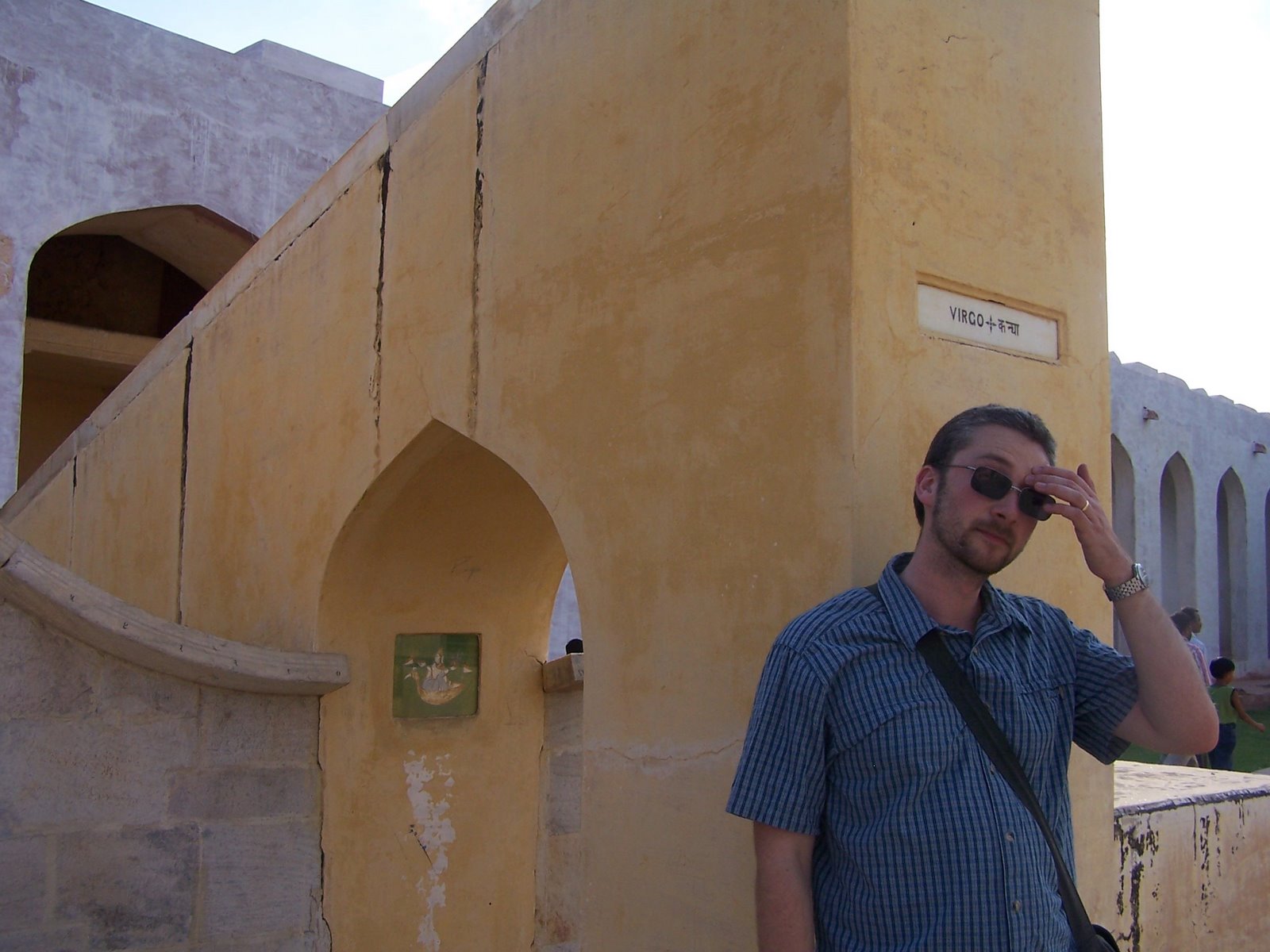
The way back to town was punctuated by a stop for a photo opportunity in front of the "Bagpiper english wine-shop" and a trip to an extortionate craft shop for tourist that we agreed to go to for our driver as he admitted he got some sort of comission (it seemed most people go to a lot more of these!). We had the driver drop us and made our own way around Jaipur as we were trying to be more independent by this point. We first went for lunch, in a place memorable for being about the only time India I saw "glamorous" women (appart from the ubiquitous pictures of bollywood actresses in any paper). Anyway, I digress.... went up a big minaret thing affrording great views accross thr city. We then went to the Jantar Mantar, an ancient observatory built by one of the Mughal emperors (see photos). The english captions on the instruments were minimal, but I found it very interesting and so different from everything else we saw. Sarah found it a bit, in her words, " another restaurant for tea before getting an autorickshaw back to the hotel. Walking to the restuber-boring". The palace/museum we went to afterwards was a bit samey after previous palaces and museums, it had a large selection of weapons, and some very impressive minature painting, but by this point we had walked a very long way that day. We headed toaurant we walked along a huge street lined with sari shop after sari shop. Thankfully these were not aimed at tourists so hassle was minimal!

Pushkar

Pushkar is about halfway between Jodhur and Jaipur, near Ajmer on the map. It's a holy town and a bit of a hippy/backpacker hangout. It was the first time we were really aware of people backpacking, rather than on tours. This meant that though you were still hassled by the locals, they were not as persistent as they realised that we were not loaded, and there were lots of cheap places to eat, unlike the Indian equivalent of tourist motorway services, where we often stopped for lunch when driving through Rajastan. The Pushkar tourist cafes also had "western dishes" which pleased Sarah, with her desire for a change from spicy food. Unfortunately everything was strangely Indian and spicy (spicy pasta, spicy pizza, etc). I'd also began to find it weird how they served pakora. It was generally not as spicy as in Scotland, and was often made from slices of potato, but that wasn't the weird part. While I was used to pakora served with a spicy yoghurt based sauce, or something more delicate, in India it comes with tomato ketchup, even in non-tourist places. Disappointing!

On the way to Pushkar we had an stressful incident where our driver stopped at a dodgy roadside local restaurant, and then ended up with a flat tire. I won't dwell on it but it was not a pleasant days travelling, and then we found out hotel had some building work going on. Thankfully the next day we were able to relax a bit in Pushkar, as there actually isn't much to do there.

Pushkar is basically a small lake will lots of temples and ghats round it. However the temples are active and the only concession to tourists in people trying to get money off you to perform a random ritual they've just made up on you. So we had a look at one temple and decided it wasn't worth the hassle to see more, and unfortunately the lakefront is basically taken up by temples. However some of the cafe's have roofs where you can actually see some of the town from. Another thing about pushkar, that you can no doubt see from the photos, is that it has quite a few monkeys around! There were not as evil seeming as those in Jaipur.

Timescales

Well now there's a reasonable amount of info on here I've started telling people about it. I should point out that these posts still refer to our first few weeks in India, and that I hope to get up to date before I leave Allahabad. (There's not so much to write about now I'm in the physics institute. ) Well I'll add a few more days now while I'm watching text updates of the thistle score over the internet.